



Dredging pump selection often looks clear on paper. A target flow rate is defined, discharge distance is calculated, and a pump curve seems to sit comfortably within the expected range. At this stage, everything appears under control. Once the dredger starts working, however, many projects discover that those early assumptions were far more fragile than expected.
Production drops below plan. Power consumption creeps upward. Wear accelerates. Operators start compensating with valve adjustments or speed changes just to keep material moving. At that point, attention turns to the pump, but in most cases the pump is only reacting to a problem created upstream.
A dredging pump does not move clean water. It moves slurry, and slurry rarely behaves in a stable or predictable way. How slurry density and particle size are treated during selection often determines whether a pump becomes a reliable part of the system or a recurring constraint.
This article looks at dredging pump selection through that lens, focusing on how slurry density and particle size behave in real projects, not in idealized calculations.
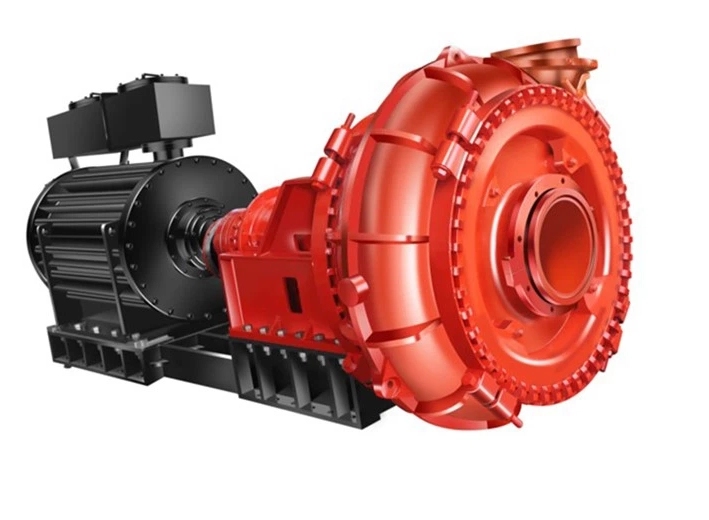
Why Slurry Density and Particle Size Decide Real Performance
In dredging work, slurry properties define the load the pump must carry day after day. Density directly affects hydraulic power demand. Particle size governs wear patterns, internal clearances, and the risk of blockage or unstable flow. These two factors are closely linked, yet they are often simplified early in the project to speed up selection.
That simplification usually holds during short trials or early commissioning. Problems tend to appear later, when digging conditions change or the operation settles into a routine. At that point, a pump that once looked well matched can drift far from its preferred operating range, even though nothing obvious has changed.
Understanding this delayed effect is critical. Most dredging pump issues are not sudden failures. They are slow shifts caused by slurry behavior that was underestimated at the start.
Slurry Density: The Risk of Designing Around One Number
Density Variation Is Built Into Dredging
In the field, slurry density is rarely stable. Cutter depth changes, soil layers vary, and water inflow fluctuates throughout the shift. Even with experienced operators, solids concentration can move up and down far more than design calculations typically assume.
Projects that define slurry density as a single fixed value often do so for convenience, not because the site supports that assumption. In practice, density peaks tend to matter more than averages, because they define the highest mechanical and hydraulic load the system must survive.
When Density Changes Become a Selection Problem
Not every density fluctuation creates risk. Short-term changes caused by operational rhythm can often be absorbed by the system. Problems arise when density increases are driven by material changes, especially when fines content begins to rise.
At that point, density no longer just increases load. It alters slurry behavior. Power demand rises, efficiency falls, and wear accelerates faster than planned. Pumps selected with limited margin may still run, but performance decays steadily, often without a clear failure event.
From an engineering perspective, this is the moment when selection assumptions begin to break down.
Particle Size Distribution and Its Quiet Influence
Average Size Tells Very Little
Many dredging specifications mention an average particle size, but this value rarely reflects how slurry behaves in operation. Fine particles and coarse particles affect pumps in very different ways. Two slurries with identical density can place completely different demands on the same pump.
Fine-rich slurry increases viscosity and changes settling behavior. Coarse particles increase impact forces and abrasion. Neither condition is inherently worse, but each requires different allowances in design and selection.
Fine-Dominant and Coarse-Dominant Slurry Behave Differently Over Time
Fine-dominant slurry often hides problems early. Flow appears smooth, vibration is low, and output meets expectations. Over time, however, internal wear progresses quickly. Clearances open up, efficiency drops, and discharge distance slowly shortens.
Coarse-dominant slurry tends to expose issues sooner. Wear is more localized and visible, but hydraulic behavior is often more predictable if passage sizes are adequate. Knowing which regime dominates a project helps engineers anticipate how performance will change, not just how it looks on day one.
Why Pump Curves Stop Telling the Full Story
Pump performance curves are usually generated under clean water conditions. Once slurry enters the picture, those curves lose accuracy. Effective head drops, required power increases, and the operating point shifts away from its ideal position.
As wear progresses, the curve shifts again. Internal leakage grows, head output declines, and energy consumption rises for the same delivered flow. In long projects, this gradual change often matters more than the initial selection.
Projects that do not plan for this shift tend to chase symptoms rather than causes, adjusting operation instead of addressing the underlying mismatch.
Turning Slurry Information Into Practical Decisions
Successful dredging pump selection is less about precise calculation and more about understanding uncertainty. Engineers need to decide whether slurry density and particle size are well characterized or only roughly estimated. They need to know whether operating conditions will remain stable or evolve over time.
When slurry properties are consistent and well understood, standard pump configurations can perform reliably. When uncertainty is high, especially with fines content or long discharge distances, selection should move beyond catalog matching and toward system-level evaluation.
This shift in mindset often makes the difference between a pump that works on paper and one that works throughout the project.
Patterns Behind Common Selection Mistakes
Across dredging projects, similar mistakes appear again and again. One is designing around average density while ignoring peak conditions. Another is assuming pilot tests represent long-term behavior, even though wear and operational variability were not part of the test.
Oversizing the pump is also common. While it may appear conservative, it often increases energy use and wear without resolving system limitations. In many cases, the real constraint lies in slurry behavior or pipeline conditions rather than pump capacity.
Knowing When Standard Selection Is No Longer Enough
Certain conditions signal higher risk. Wide density variation, limited particle size data, and discharge distances close to theoretical limits all increase uncertainty. In these situations, pump selection becomes less about efficiency and more about system resilience.
At this stage, engineers are no longer just choosing equipment. They are deciding how much variability the system can tolerate without compromising production or maintenance planning.
Recognizing this threshold early helps avoid costly adjustments later in the project.
Why System-Level Thinking Reduces Long-Term Risk
Dredging pump performance cannot be separated from slurry behavior, pipeline losses, and wear progression. Treating selection as a system decision rather than a component purchase produces more predictable results.
Projects that adopt this approach tend to experience steadier output, fewer operational surprises, and better control over lifecycle cost, particularly in long-running or technically demanding dredging work.
About TRODAT (Shandong) Marine Engineering Co., Ltd.
TRODAT (Shandong) Marine Engineering Co., Ltd. provides dredging equipment and marine engineering solutions for a range of waterway projects. With practical experience in dredging operations, the company supplies dredging pumps and related systems designed around real working conditions rather than simplified assumptions.
By combining equipment supply with engineering-focused support, TRODAT assists clients in addressing slurry variability, wear behavior, and operational challenges encountered in port construction, river dredging, and environmental remediation.
Conclusion
Selecting a dredging pump based on slurry density and particle size requires more than matching curves to numbers. It requires an understanding of how slurry properties change over time, how particle size influences wear and stability, and how those factors interact with the rest of the system.
Projects that approach pump selection as part of a broader engineering decision, rather than a standalone purchase, are far more likely to maintain stable discharge distance and predictable production throughout the project lifecycle.
FAQs
How does slurry density affect dredging pump selection?
Slurry density influences power demand, achievable head, and operating stability. Selection should account for realistic density ranges rather than relying on a single design value.
Why is particle size distribution important when choosing a dredging pump?
Particle size distribution affects wear behavior, blockage risk, and long-term performance. Fine-dominant and coarse-dominant slurries impose different demands on pump design.
Can one dredging pump handle varying slurry conditions?
A dredging pump can handle variation within limits, but wide fluctuations often require system-level evaluation to maintain reliable operation.
Why does dredging pump performance decline over time?
Wear increases internal clearances, reducing effective head and efficiency. Slurry characteristics accelerate this process if not considered during selection.
When should engineers consider system-level support?
System-level support is advisable when slurry properties are uncertain, discharge distances are long, or operating conditions vary significantly during the project.

Post Comment