



If you are sizing a dredging or slurry transport system, how to choose wear-resistant pump materials for abrasive slurry is not a catalog question—it is a field question. The “right” material depends on what your slurry actually contains (particle size distribution, angularity, and hardness), how your system runs (head, velocity, and system losses), and how much variability shows up across a shift. Pick based on a single “average” and you often end up paying for it later—in efficiency, production, and rebuild frequency.
Answer: How to Choose Wear-Resistant Pump Materials for Abrasive Slurry
Choose wear-resistant pump materials by matching the dominant wear mechanism to the real particle size distribution and operating regime, then validating with simple site measurements before you lock the design.
When slurry is coarse and impact-driven, you need materials and geometries that tolerate repeated particle strikes at high relative velocity. When slurry is fine-rich and sliding abrasion dominates, you need surfaces that resist continuous scouring and maintain tight clearances longer. When corrosion and abrasion stack together (common in seawater or chemically active water), a “hard” choice on paper can fail early because corrosion undermines the surface and accelerates wear.
The practical approach is to start with verification: confirm particle size distribution (not just a single size), confirm solids concentration and density behavior, and confirm the head/velocity your pipeline really demands. Once those are proven, you can choose materials for the wet-end parts that take the hit first—impeller, liner, volute, throatbush, and suction-side components—while keeping maintainability in mind (replaceable wear rings, modular liners, and predictable rebuild cycles).
Why Particle Size Drives Abrasion in the Real World
Particle size distribution matters more than the “average”
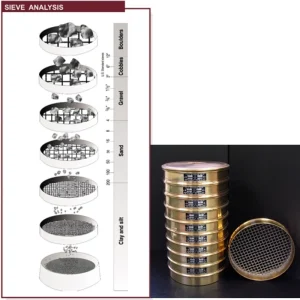
Two slurries can share the same reported particle size and still destroy pump parts at very different rates. The reason is distribution. A small percentage of oversize particles can dominate wear, especially when they are angular and hard. Engineers often talk about D50 or “median size,” but D90 (or even the top end of the distribution) is where abrasion decisions become real, because those coarse particles are the ones that strike and cut.
In dredging, the distribution can swing quickly when you change cutter depth, move into a new layer, or pull more gravel than planned. That swing is the start of most “mysterious” wear problems. What looks like a pump issue is often a material mismatch to the day-to-day particle mix.
Impact abrasion vs sliding abrasion: the mechanism changes the material choice
Coarser particles tend to cause impact abrasion: repeated collisions that chip, gouge, and fatigue the surface. Finer particles trend toward sliding abrasion: continuous scouring that gradually opens clearances and reduces hydraulic efficiency. Mixed slurries can produce both at once—impact at the leading edges and throat areas, sliding on liners and volute passages.
This is why “harder is always better” is a trap. A very hard material can resist cutting but may crack or chip under repeated impact. A tougher, more elastic surface can absorb impact, but may erode faster under sustained sliding abrasion.
System losses, head, and velocity quietly set the wear rate
Wear is not only about what is in the slurry. It is also about how fast that slurry moves and where energy is lost. Higher velocity raises particle strike energy. Higher head demand often leads operators to run higher speed or farther from best efficiency point, increasing recirculation, turbulence, and localized wear.
This is the hidden link between abrasion and production. When efficiency drops, you lose output for the same power. Operators respond by pushing speed, opening valves, or adjusting operating points—actions that can increase wear again. It becomes a loop: wear reduces efficiency, efficiency loss reduces production, production pressure increases operating stress, and stress increases wear.
How to Verify Particle Size and Abrasion Risk Before You Decide
Start with a representative sample, not a “clean” sample
If you sample from a calm area or after settling, you bias the results toward fines. If you sample only during stable operation, you miss peaks. A useful approach is to take samples at multiple times in the shift, including moments when the cutter is changing depth or when operators report that load feels different. The goal is not a perfect lab-grade dataset; it is a realistic range that reflects variability.
Use practical tests that connect to decisions
A full lab analysis is valuable, but many projects can make a better material decision with a few basic checks:
A sieve-based screen test can quickly show whether you have a significant oversize tail. Even a rough split into “fine,” “medium,” and “coarse” buckets tells you whether impact abrasion will dominate.
If the slurry contains a lot of fines, the next question is whether viscosity effects show up at operating concentration. Fine-rich slurry can behave like thickened fluid rather than water with particles, especially when solids concentration rises. That behavior affects pump performance curves and can shift the operating point into a less forgiving zone.
Confirm density behavior, because density and size work together
Abrasion risk increases when solids concentration rises, even if particle size stays the same, because more particles pass through the pump per unit time and internal turbulence changes. In many dredging projects, density does not stay stable. It follows digging rhythm, water inflow, and soil layers.
If you need a reference on how density and particle size interact during selection, link the reader to your existing asset early, because it frames why “one number” is not enough: slurry density and particle size selection guide. (This also supports search coverage for density variability and real-site behavior.)
Validate wear with operating symptoms, not just visual inspection
Wear usually announces itself in performance before it becomes visually obvious. A widening clearance often shows up as reduced head at the same speed, higher power draw for the same production, or a gradual drop in discharge rate even though the pipeline layout has not changed.
If you can log suction pressure, discharge pressure, speed, and motor power over time, you can spot efficiency drift early. That drift tells you whether you are fighting sliding abrasion (steady decline) or impact-driven damage (step changes after coarse material events). Those patterns help confirm whether the material you are considering matches the wear mode you are seeing.
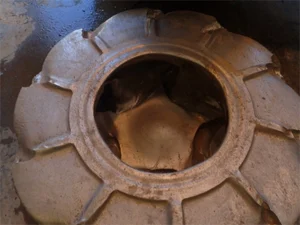
What Wear-Resistant Pump Materials Actually Do Well
High-hardness metallic materials for cutting and scouring
High-hardness alloys are often chosen because they resist cutting and maintain profile longer in abrasive service. They tend to perform well in sliding abrasion environments, where the main failure mode is gradual erosion rather than sudden impact damage.
The trade-off is brittleness. In a gravel-heavy slurry with repeated impacts, very hard surfaces can chip, especially at leading edges and high-turbulence zones. When that happens, the wear rate can accelerate because chipped areas create turbulence and concentrate stress.
Tougher metallic materials for combined abrasion and corrosion
If you are in seawater or chemically aggressive environments, corrosion can remove protective layers and undercut the surface. Abrasion then strips the weakened material faster. In those cases, toughness and corrosion resistance can matter as much as hardness.
A material that survives pure abrasion in freshwater may fail much faster when corrosion-abrasion is present. The correct decision often depends on whether corrosion is merely a background factor or a true co-driver of wear.
Elastomeric liners for impact absorption and fines behavior
Rubber and polyurethane-style liners can perform very well in certain slurries because they absorb particle energy instead of fracturing. They are often effective when impact is frequent but not extremely sharp, and when fines content is high enough that sliding abrasion is less like “sandpaper on steel” and more like controlled scouring.
The limitation is temperature, chemical exposure, and sharp, large particles. Very angular gravel can tear or gouge elastomers. If your particle size distribution has a strong coarse tail, elastomer protection may need to be limited to zones where impact is lower and replacement is easy.
Coatings and composite approaches when geometry and maintenance allow it
Hard coatings and composite wear surfaces can be effective when you can control surface integrity and replacement strategy. They are typically best used where the substrate is well supported and where inspection intervals are realistic. If coating damage is hard to detect until failure, the project can lose the very predictability that coatings are supposed to provide.
In practice, coatings are most successful when they are part of a maintainable wear strategy rather than a last-minute fix to extend life without changing operating conditions.
Matching Materials to Real Operating Conditions (and Keeping Production in Mind)
Coarse sand and gravel: protect the leading edges and throat zones
When particle size skews coarse, impact zones dominate. This is where chipping risk rises, and where geometry and clearances can change quickly if the wrong material is used. In these cases, you want a solution that can tolerate repeated strikes without brittle fracture, and you want wear parts designed for replacement rather than “run to failure.”
A practical question to ask is whether the project can schedule planned wear-part changes without losing production windows. If yes, a design that uses replaceable liners and wear rings can be more valuable than a single “strongest” material that forces longer downtime when it finally fails.
Fine-rich slurry: control clearances and protect efficiency
When fines dominate, sliding abrasion and hydraulic losses become the main issue. The pump may not fail dramatically, but performance drifts. Head drops, efficiency declines, and production slowly slips below plan. This is where material choice should prioritize maintaining profiles and clearances, because efficiency is production in disguise.
If your system has high head demand and long discharge distance, small efficiency losses can translate into large production losses. In that scenario, selecting materials that preserve hydraulic shape can be worth more than selecting for maximum mechanical toughness alone.
Mixed and variable conditions: design for variability, not for the “average”
Most real sites are mixed. Density swings. Particle mix changes. The best strategy is often not a single material decision, but a system decision: select materials for the most damaging peaks, then add operational margins so you are not forced to run the pump in a punishing regime.
This is also where readers want actionable advice that many ranking pages skip: connect material choice to system losses and operating behavior. If your pipeline configuration or head requirement forces you to run too far from a stable point, no material will “save” the pump. It will only determine how quickly wear becomes a production problem.
How to Extend Wear Life Without Changing the Pump Model
Reduce unnecessary velocity and turbulence
Abrasion rises fast with velocity. If you can reduce turbulence zones—sharp bends near the pump, abrupt expansions, poorly aligned fittings—you often reduce localized wear more than you would by changing a single component material.
This is not about making the system “perfect.” It is about removing obvious loss points that force the pump to work harder than needed. That improves efficiency and production while reducing wear.
Keep the pump closer to its stable operating range
Running far from best efficiency point increases recirculation and internal turbulence. That turbulence can accelerate liner wear and damage leading edges. If operators must frequently “chase” production by changing speed or throttling, treat it as a system design warning, not a training issue.
Build a predictable wear program
If wear parts are accessible and replacement intervals are predictable, you can treat wear as planned maintenance instead of unplanned downtime. That is often what B2B buyers really want: not “zero wear,” but stable wear rates that support scheduling, spares planning, and consistent production.
If you are evaluating wet-end configurations and wear part strategies, the most direct way to see your options is to review the available pump categories and configurations in one place: dredging pump product range.
About TRODAT (SHANDONG) MARINE ENGINEERING CO., LTD
TRODAT (SHANDONG) MARINE ENGINEERING CO., LTD supplies dredging equipment and supporting systems for dredgers and slurry transport projects, covering wet-end pumping equipment as well as related marine and dredging components. The company positions itself as a long-term technical partner for projects that need stable performance under changing site conditions.
For project teams that need hands-on onboarding and operational stability after commissioning, TRODAT also offers service support focused on training after installation: after-sales training and service support.
If you want a concise overview of TRODAT’s scope, experience positioning, and equipment coverage, see: About TRODAT (SHANDONG) MARINE ENGINEERING CO., LTD.
Conclusion
Choosing wear-resistant pump materials is not a one-line spec choice. It is a risk-management decision tied to particle size distribution, abrasion mechanism, density behavior, and the head and system losses your pipeline imposes. When you verify the slurry you will actually pump—and you connect material selection to operating range, maintainability, and production stability—you get a wet-end that wears predictably, protects efficiency, and supports real job-site output.
FAQs
What pump material is best for abrasive slurry with coarse sand or gravel?
In coarse, impact-heavy slurry, you generally need a wet-end strategy that resists chipping and handles repeated particle strikes, especially at leading edges and throat zones. The “best” choice is usually the one that survives impact without brittle damage and supports planned replacement of wear parts when production schedules matter.
How do I measure particle size distribution for dredging slurry on site?
A practical start is to take representative samples across a shift and run a sieve-style screen separation to see whether a coarse tail exists. If fines are dominant, add a method that helps estimate how much fine content changes behavior at operating concentration, because fine-rich slurry can shift performance and wear patterns even when “size” looks small.
Why does my pump wear faster when slurry density increases?
Higher density typically means more solids moving through the pump per unit time, which increases particle interactions, turbulence, and the rate of scouring or impact. Density increases can also push the pump further from its stable operating point, raising internal recirculation and accelerating wear through efficiency loss and localized turbulence.
How can I tell if abrasion is causing production loss before the pump fails?
Watch for performance drift: reduced discharge at the same speed, higher power draw for the same output, or falling discharge pressure without a layout change. Those trends often show clearance growth and hydraulic shape loss before visible damage becomes obvious.
Should I change materials or fix the pipeline system first?
If the system is forcing the pump into a punishing regime—high head demand, excessive velocity, or frequent off-range operation—fixing the system losses often delivers bigger gains than a material change alone. Material selection works best when the operating window is realistic and the pump is not constantly being pushed to compensate for avoidable losses.

Post Comment