



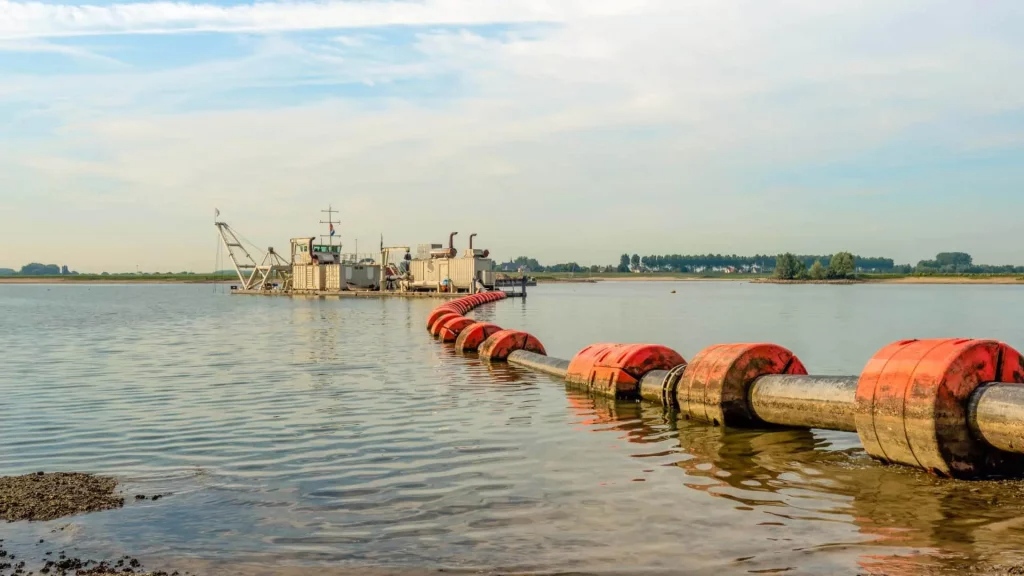
Dredge pipeline floats serve as essential components in suction and discharge systems, keeping lines elevated and stable throughout dredging work. When buoyancy falls short, sections sag under the load of pipe walls plus dense slurry, leading to higher pump demands, faster abrasion, blockages, and potential breaks that halt operations for hours or days. Field experience shows these interruptions in major harbor deepening or river maintenance can cost tens of thousands daily. This overview covers practical selection criteria for floats matched to steel pipe, HDPE pipe, and rubber dredging hoses, grounded in real buoyancy needs, material behaviors, and site conditions to guide procurement choices effectively.
Why Proper Float Selection Matters in Dredging Operations
Dredging pipelines transport mixtures that often reach densities of 1.3 to 1.5 times water, adding substantial weight over extended reaches. Inadequate support causes drooping, which amplifies friction against the bottom or increases resistance in flow, pushing energy consumption higher and wearing components prematurely. Stable lines reduce these issues, maintain consistent pumping rates, and limit unplanned stops.
Project settings vary widely. Coastal sites face persistent waves and tides that test float anchorage and impact resistance. River channels bring shifting currents and sediment buildup, demanding even distribution to avoid localized stress. Land reclamation frequently involves calmer, shallower expanses but longer floating stretches where consistent elevation prevents settling.
Discrete floats attached at intervals provide advantages over integrated self-floating hoses in many setups. They allow precise buoyancy placement, straightforward replacement of individual units, and adaptability when mixing pipe types along the line. Correct sizing and positioning keep drag low, protect against excessive bending, and extend operational reliability across diverse dredging tasks.
Main Types of Dredge Pipeline Floats
Several float designs address different demands in the field. Modular clamshell types, built from rotationally molded high-density polyethylene shells filled with closed-cell foam, see the widest use because they clamp on quickly without breaking the line. Their split construction simplifies handling and adjustments during deployment or reconfiguration.
Foam-filled models deliver consistent buoyancy with solid resistance to impacts, fitting well where hoses experience frequent flexing. Pipe-through variants route the line directly through a central passage, suiting fixed or semi-permanent arrangements. Steel floats, though encountered less often now, offer unmatched load-bearing capacity for very heavy or large-diameter steel sections under severe conditions.
A side-by-side look at characteristics shows clear distinctions. Clamshell HDPE floats handle broad diameter ranges with strong buoyancy retention and proven resistance to UV exposure and surface wear. Foam-filled versions align closely with rubber hoses that need to bend without restriction. Steel options manage extreme weights but introduce added mass and call for corrosion barriers in aggressive waters.
Key Factors for Selecting Dredge Pipe Floats
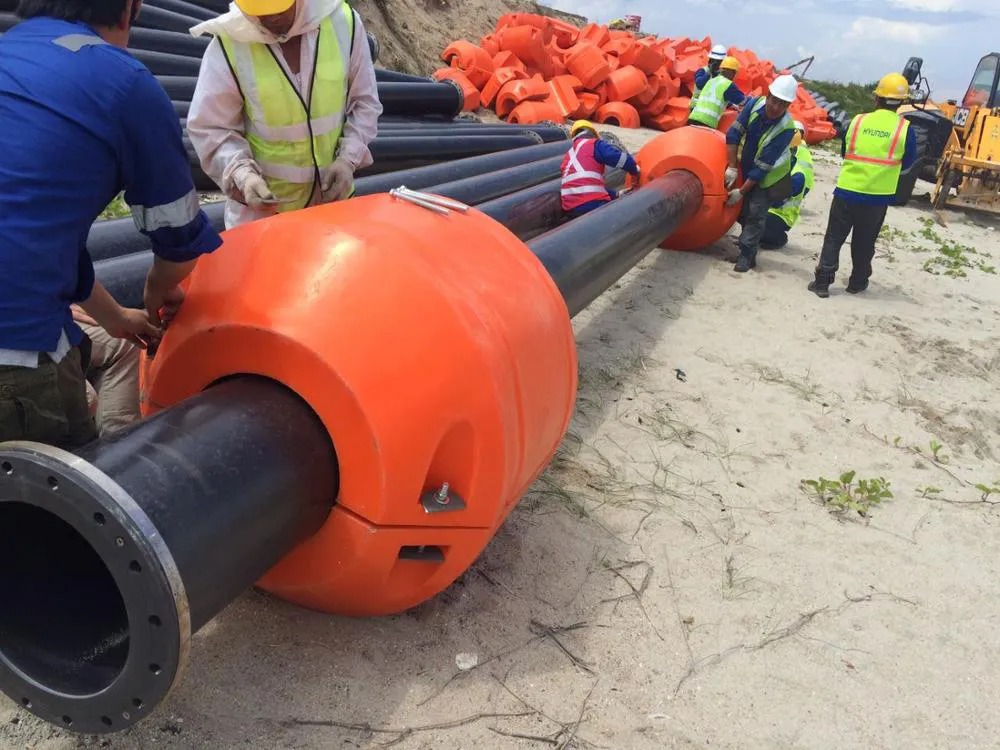
Decisions rest on pipeline specifics, surrounding conditions, and operational realities. Each element shapes buoyancy targets, attachment methods, and expected longevity.
Pipeline Material and Diameter
Steel pipes bring high mass and stiffness, requiring floats that offset considerable submerged loads while securing firmly to rigid walls. Discharge lines under high pressure often use these, so contact surfaces must avoid accelerating corrosion in brackish or seawater.
HDPE pipes offer low weight and built-in resistance to chemical attack, suiting both suction and discharge runs. Floats matched to HDPE typically share similar material traits to minimize scoring at clamp points and maintain a tight, non-deforming grip.
Rubber dredging hoses provide the flexibility needed near cutter heads or in articulated sections. Floats here should feature compliant inner linings or designs that prevent cutting into the outer cover during movement, with clamshell or through-pipe styles performing reliably.
Diameter governs float scale. Lines from 6 to 10 inches pair with compact units, whereas 20- to 32-inch pipes need larger-capacity models to spread support evenly and avoid point loading.
Buoyancy Requirements and Calculation
Floats must generate enough upward force to hold the line near the surface, generally leaving 25 to 33 percent exposed for visibility and reserve stability against surges. The process starts with totaling submerged weight per meter.
Begin with the pipe’s dry weight per meter, derived from material density and thickness. Factor in slurry weight inside, based on an average 1.3 to 1.4 tons per cubic meter for common dredging mixes. Apply a safety margin of 1.2 to 1.5 times to cover dynamic effects like wave action, current pull, or uneven slurry distribution.
Required buoyancy per meter equals this adjusted total. Divide by the net buoyancy of a single float—typically rated at partial submersion—to determine units needed per section. Resulting spacing tends toward 1.5 to 2 meters for heavier rubber hoses, extending to 4 to 6 meters for lighter HDPE in protected waters.
Consider a 500-millimeter HDPE discharge line with 1.3-density contents. Submerged weight might run 150 to 200 kilograms per meter. Adding margin pushes the target to 240 to 300 kilograms per meter. A float rated at 400 kilograms buoyancy at half submersion suggests intervals around 1.5 to 2 meters. Actual deployment often involves fine-tuning after observing sag or float submersion in operation.
Water and Environmental Conditions
Wave amplitude, flow velocity, salinity levels, ultraviolet intensity, and temperature ranges dictate material and structural choices. Exposed coastal zones call for streamlined shapes that reduce drag and reinforced exteriors to withstand debris strikes. Salt accelerates degradation on unprotected hardware, favoring UV-stabilized HDPE shells and corrosion-resistant fasteners.
Foam cores in filled models must resist water penetration under thermal cycling. Shallow river work with floating debris prioritizes impact toughness over other traits.
Float Spacing and Arrangement
Uniform intervals avoid concentrated bending or stress risers. Standard practice places three to four floats per 12-meter pipe in lighter-duty water transport, rising to six or seven when dense slurry flows. Rubber hoses generally require tighter patterns due to reduced natural rigidity.
Patterns may stagger or align depending on predominant wave or current direction. Attachments using galvanized bolts or heavy straps must tighten to recommended torque to resist vibration-induced loosening.
Durability, Installation, and Maintenance
Long-term performance hinges on shell integrity—rotationally molded HDPE withstands cracking and color fade well, while sealed foam prevents sinking from breaches. Installation follows straightforward steps: clean contact areas, position units evenly along the line, and secure fasteners sequentially.
Regular inspections catch early signs such as loosened clamps, surface fissures, or moisture in foam types. Prompt replacement of compromised floats prevents cascading failures across the system.
Precautions and Common Mistakes to Avoid
Field issues often trace back to predictable oversights. Inadequate buoyancy allowance results in excessive submersion, raising hydrodynamic drag and straining pumps unnecessarily. Excessive spacing invites mid-span droop, particularly under full slurry load.
Pairing rigid clamp styles with highly flexible rubber hoses risks surface cuts or ovaling. Neglecting the safety factor leaves lines vulnerable to storm surges or passing vessel wakes.
Installation errors like inconsistent torque or poor alignment create vulnerabilities. Overlooking periodic checks allows corrosion on bolts or minor shell damage to grow into major service interruptions.
Systematic buoyancy verification, material-specific matching, and scheduled reviews cut these risks substantially and prolong asset service intervals.
Case Studies and Real-World Recommendations
Port deepening projects spanning hundreds of meters have paired HDPE discharge pipes with clamshell floats at 2.5-meter centers, holding elevation steady in moderate tidal flows and supporting uninterrupted high-throughput pumping.
Sand extraction from inland rivers has relied on rubber suction hoses fitted with foam-filled floats at 1.8-meter spacing. This arrangement absorbed flex around channel bends, limiting fatigue in the hose wall and sustaining suction head.
Heavy steel pipelines in offshore aggregate recovery used high-capacity modular floats to manage elevated weights reliably across extended floating reaches.
About TRODAT (SHANDONG) MARINE ENGINEERING CO., LTD
TRODAT (SHANDONG) MARINE ENGINEERING CO., LTD supplies comprehensive dredging equipment and components, including suction and discharge pipeline systems configured for varied project demands. Drawing on more than 15 years in marine and dredging sectors, with some areas exceeding 20 years of involvement, the company covers power systems, dredging devices, deck machinery, outfitting, and specialized instrumentation. All production aligns with ISO9001:2015 quality protocols, and IACS certification supports marine-classified items. Manufacturing occurs across strategic industrial zones in China, backed by established supply chains and technical resources to deliver consistent quality for new installations, refits, and ongoing support globally.
Conclusion
Matching dredge pipeline floats to steel pipe, HDPE pipe, or rubber dredging hoses demands careful weighing of material properties, calculated buoyancy, site-specific stresses, and installation details. Precise engineering in these areas yields reliable floating lines, curbs operational interruptions, and controls long-term maintenance expenses. Procurement focused on proven compatibility and field-verified performance delivers measurable gains in project efficiency.
FAQs
How do I calculate buoyancy needed for dredge pipeline floats on HDPE pipe?
Determine submerged weight per meter for the pipe and slurry contents, then multiply by a 1.2 to 1.5 safety factor. Divide the result by individual float buoyancy rating to set spacing. Typical HDPE lines with 1.3-density slurry target support that keeps 25 to 33 percent of the float above water.
What float type works best for rubber dredging hoses?
Foam-filled or clamshell designs featuring compliant inner surfaces suit rubber hoses effectively. These handle repeated bending without damaging the cover, and spacing around 1.5 to 2 meters prevents undue sag or kinking in dynamic sections.
Why does steel pipe need different float considerations compared to HDPE?
Steel pipe’s greater density and rigidity call for higher buoyancy per unit and stronger attachment methods. Corrosion protection gains importance in saline settings, and spacing can extend slightly thanks to the pipe’s inherent stiffness.
How far apart should dredge pipe floats be placed on slurry discharge lines?
Intervals depend on pipe type and contents density. Dense slurry often requires 1.5 to 3 meters to control sag, while lighter water transport permits 4 to 6 meters. Buoyancy math provides the baseline, with on-site adjustments based on actual line behavior.
What common mistake leads to early failure of dredge pipeline floats?
Running insufficient buoyancy margin or inconsistent spacing ranks highest. Without adequate reserve, waves, currents, or load spikes submerge floats excessively, increasing drag and accelerating wear on floats and connected pipe.

Post Comment